
METEOR is an easily implemented and cost-effective technology to boost oil recovery. It is applicable in multiple reservoir environments.
In Steam-based oil sands operations, it can increase recovery & decrease GHG emissions.
In conventional reservoirs, it can be used in conjunction with waterflooding to increase oil recovery.

METEOR & SAGD
- Enhanced production with no additional steam
- 38% more production; 27% lower steam-to-oil-ratio
Lower GHG emissions and also increase oil recovery. METEOR can lower the per-barrel cost of production and improve the quality oil recovered.
METEOR combines dormant microorganisms in the reservoir with thermal recovery in a way that is quite unlike traditional microbial enhanced oil recovery (MEOR) strategies. This new approach distributes nutrients to microbes that have been activated by warmth conducted into zones adjacent to the steam chamber. The microbes create biogas in an evenly distributed fashion thanks to their naturally ubiquitous distribution throughout the reservoir rock.
Reducing GHG Emissions
METEOR is based on the use of dormant thermophilic bacterial endospores that are ubiquitous in sedimentary environments including oil sands. Stimulating denitrification (N2 biogas generation) during conductive heating of IHS layers to temperatures conducive to thermophile metabolism generates climate-friendly gases that mobilize and produce oil from IHS.
Conductive heating from the steam chamber below IHS provides the heat required for the METEOR process, such that additional oil production requires no additional steam, resulting in lower SOR.

Increase in Biogas Production with Lower Emissions
- Microbial metabolism increases with temperature
- Dramatic temperature increases kill the microbial majority, but awaken dormant thermophiles
- Nutrient addition increases the rate of microbial metabolism and aids recovery
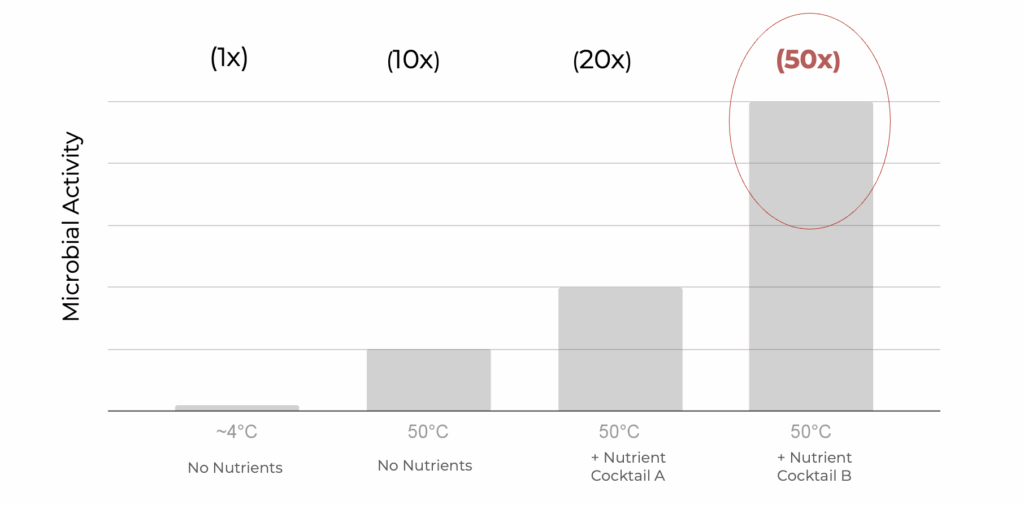
With the right nutrient cocktail and temperature change, biogas production can be enhanced by 50x
Bars compare similar experiments and demonstrate how microbial metabolism (and hence biogas production) are enhanced by heat and nutrients in combination.
METEOR in Conventional Reservoirs
METEOR leverages microbial metabolism in ‘deep biosphere’ oil reservoir habitats to significantly improve waterflooding efficiency and increase oil recovery. It is compatible with both new and ongoing water injection operations and requires minimal additional cost for a typical waterflooding operation.
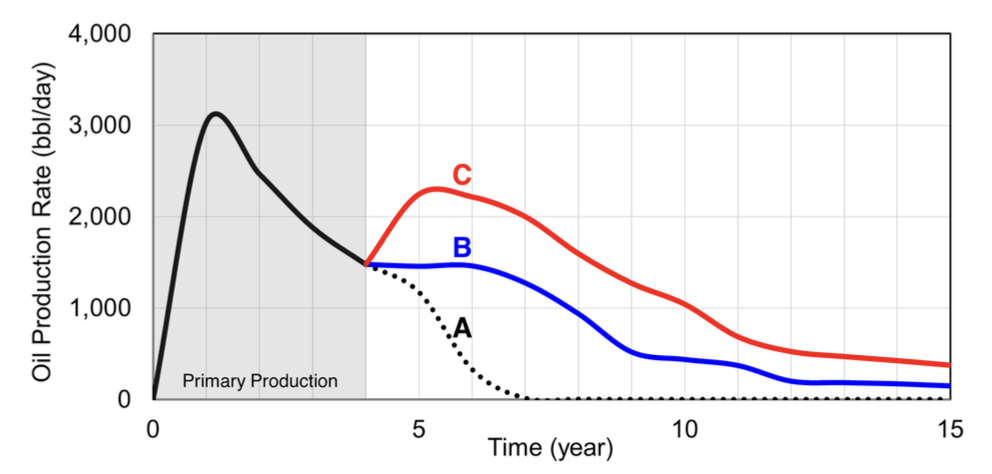
METEOR can be applied any time during waterflooding stage to improve oil production (red line). Reservoir modelling projects METEOR significantly improving the initial waterflooding oil production rate, with even more production relative to waterflooding over a 10-year period. It is easily integrated with existing waterflooding infrastructure and safer than gas injection.
Water flooding
Water flooding
METEOR facilitates microbial metabolism in oil reservoirs to generate biogas (N2). This gas in turn displaces oil from porous reservoir rock, increasing oil recovery. The patented METEOR process can be implemented either at the start of waterflooding or after years of production. In-situ N2 generation enhances sweep efficiency and can immediately boost overall waterflooding efficiency by 50%.
Process
The proprietary patented METEOR technology is tailored to maximize in situ production of nitrogen (N2). This biogas is benign (safe) from an operational and an environmental standpoint.
The process is easily controlled by the rate and location of nutrient injection. The resulting production strategy in SAGD operations differs fundamentally from the traditional idea of injecting a fluid to push oil from one well to another. In conventional reservoirs when used with waterflooding, the injection process is determined based on individual reservoir characteristics.

Why N2?
- Non-condensable gas (N2 biogas) is generated in situ, catalyzed by heat & nutrient (N) activation of dormant thermophiles.
- Microbial denitrification (conversion of nitrate to N2) via METEOR is fast, occurring within just a few days.
- The generated gas increases reservoir pressure, reduces viscosity and provides other production benefits for the product
- Bioconversion of liquid nitrate into N2 biogas can increase fluid volume up to 40x.
- Nitrate is a well-understood additive commonly injected into oil reservoirs for H2S (souring) control.
- Nitrate poses no risk to well and facility infrastructure.
- N2 is a climate-friendly gas that maintains similar benefits as other non-condensable gases.
- Laboratory tests demonstrate that N2 biogas generation by METEOR displaces oil out of porous media.
- METEOR has been developed and validated through laboratory testing and CMG STARS modeling.